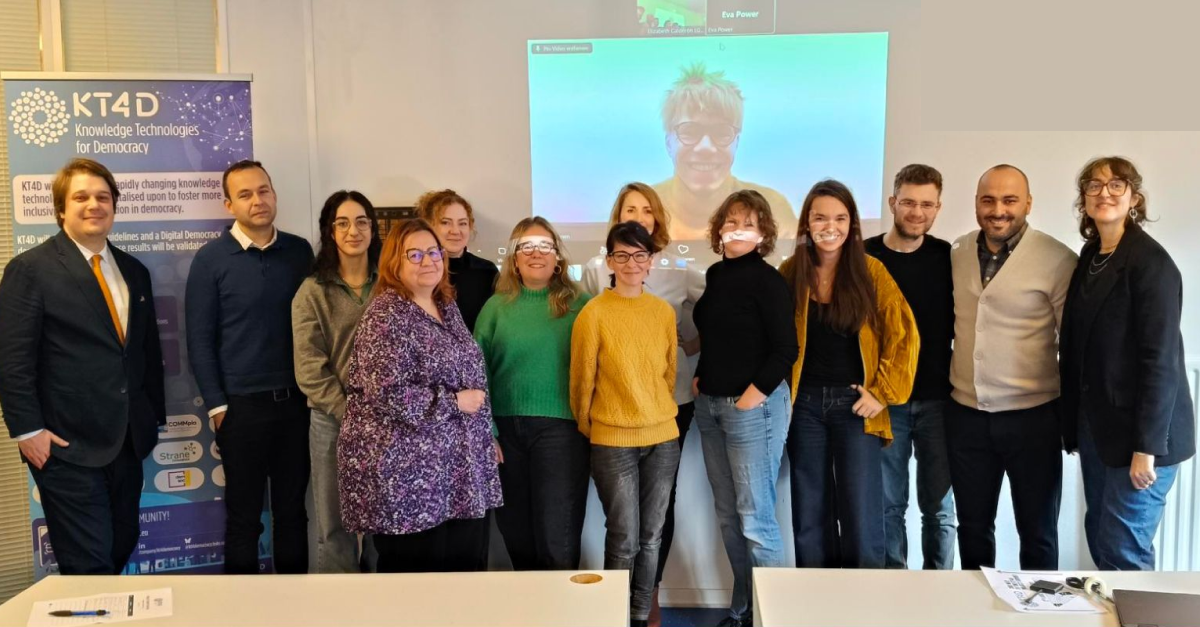
Trust-IT played a key role in the successful delivery of the KT4D final event, “Beyond the Algorithm”, held on 4 December in Brussels, marking an important milestone both for the project and for the AI, Big Data & Democracy Task Force.
The event brought together results from four Horizon Europe projects — KT4D, AI4Gov, ITHACA and ORBIS — to examine the relationship between artificial intelligence and democratic resilience. Convened by the AI, Big Data & Democracy Task Force in cooperation with the European Alliance for Social Science and Humanities, the conference confirmed KT4D’s position as a reference initiative within this thematic area.
A consolidated role within the AI, Big Data & Democracy Task Force
The Task Force was originally initiated by KT4D together with the AI4Gov, ITHACA and ORBIS projects and subsequently further developed and operationalised by Trust-IT, which has led its communication and dissemination activities.
Over time, the Task Force has expanded from four to eight Horizon Europe projects, strengthening collaboration and alignment among initiatives addressing democracy, AI and data governance. Trust-IT has actively supported this growth by promoting the Task Force as a shared platform for exchange, coordination and joint valorisation of results.
During the Brussels event, KT4D — supported by Trust-IT — was explicitly acknowledged by partner projects, Project Officers and participants for its leading role in the scientific, technical and organisational coordination of the conference. The strategic inclusion of INNOVADE, where Trust-IT also leads communication and dissemination activities, ensures continuity of this leadership within a thematic area of increasing relevance for the European Commission.
Key reflections from “Beyond the Algorithm”
Discussions across the event highlighted a shared understanding of the tensions between technological optimisation and democratic processes.
KT4D introduced the concept of “Democracy in the Loop”, emphasising the need to design AI systems that preserve deliberation, disagreement and human judgement as core democratic elements. Rather than minimising friction, the framework argues for embedding it intentionally to ensure that technology adapts to democratic values.
Trust and governance emerged as another central theme. Speakers stressed that trust in AI cannot rely solely on technical compliance but requires robust governance mechanisms that protect vulnerable and marginalised groups. In this context, proposals such as an EU-level certification for bias mitigation, discussed within AI4Gov, illustrated possible approaches to responsible AI deployment in the public sector.
The event also underlined the importance of critical digital literacy, moving beyond technical skills towards citizens’ capacity to assess the societal and democratic implications of digital tools. Across panels, there was broad agreement that AI should function as a supporting instrument, helping humans manage complexity while preserving human agency and decision-making.
Ensuring visibility and long-term impact
In addition to its role in organising and coordinating the event, Trust-IT ensured on-site communication and documentation, capturing the discussions and managing the exhibition booth dedicated to showcasing KT4D results and tools. This contributed to extending the project’s impact beyond the event itself.
The conference also provided opportunities for exchange with representatives of the European Commission, including Anne Haglund-Morrissey, Deputy Head of Unit (Democracy, Equality and Culture – DG RTD), and Maria Claudia Bodino, whose feedback highlighted the relevance of KT4D and the Task Force’s work at the intersection of AI, Big Data and democracy.
Next steps for KT4D
On 5 December, Trust-IT participated in the KT4D final project summit and General Assembly, reviewing recent activities and planning the remaining work until the project’s conclusion on 31 January 2026. Through its involvement in KT4D and the AI, Big Data & Democracy Task Force, Trust-IT continues to strengthen its role in supporting European research projects, fostering coordination, visibility and impact in critical policy-relevant domains.