Anniversaries in research infrastructure rarely make national headlines. And yet, without it, we would still be using boxes and registers to store important data. University professors and students would not be able to access thousands of important research outputs. The speed at which we innovate would begin to stall.
A decade is long enough to see a pattern of change in how research data is stored, managed and shared. Many ideas that EUDAT’s founding members committed to in 2016 – especially to sharing data across bored and disciplines, with easily identifiable data – has since become the shared value and part of the official vocabulary for European R&I agenda. But let’s take a look at when such values felt extraordinary.
The promise and commitment of 2016
The conceptualisation of EUDAT and what It could be goes back to the 2010 report Riding the Wave, in which the High Level Expert Group on Scientific Data called for a Collaborative Data Infrastructure for Europe. In 2011 the CDI was presented as "the vision for the future", and a first EU-funded EUDAT project began turning it into services. EUDAT2020, coordinated by CSC – IT Center for Science in Finland, followed under Horizon 2020 from March 2015 (CORDIS).
However, maintenance of data and its survival is not only a question of technical expertise, but that of governance and funding. On 27 September 2016, a first wave of 16 organisations signed the EUDAT Collaborative Data Infrastructure Agreement for an initial period of ten years. The agreement set out each party's roles and responsibilities, an open governance framework, and a Secretariat to sustain the collaboration beyond the project cycle.
The signatories, announced on 3 October 2016, read like a map of European research computing: BSC, CERN, CINECA, CINES, CSC, DANS, DKRZ, GRNET, Jisc, Jülich, KIT, MPCDF, PSNC, STFC, SURFsara and UNINETT Sigma2 — 16 organisations from 11 countries. Four more followed: ICOS ERIC, University College London, the University of Edinburgh and the Swedish National Infrastructure for Computing (EUDAT news, 2016).
The signatories committed to develop, maintain and deploy pan-European research data services, and to harmonise data management practices across centres. The services had been shaped with more than 50 research communities. The founding idea was simple to state and hard to do, as it sought to bring together the diversity of research and its community and ensure continuous support by European largest data and computing centres.
The acceleration of European research
To understand why the 2016 agreement mattered, it helps to remember what research data management looked like at the time. The FAIR Guiding Principles, rooted in making data Findable, Accessible, Interoperable, Reusable, had only just been formally published, in Scientific Data on 15 March 2016 (Leiden University). The European Open Science Cloud was still a policy ambition; EUDAT's own announcement described its realisation as "imminent".
In practice, much research data lived on project servers, institutional drives, and researchers' laptops. Data management plans existed, but under Horizon 2020, projects could still opt out of the Open Research Data Pilot (ESE). Each research infrastructure tended to build its own storage, identifiers, and access systems in silos.
Ten years later, the picture is very different:
- FAIR became policy, and not simply an aspiration. Under Horizon Europe, managing data through a Data Management Plan and providing FAIR data "as open as possible, as closed as necessary" are mandatory practices (REA).
- EOSC became operational. In October 2026 the EOSC Federation entered its operational phase: the EOSC EU Node plus 27 national, thematic and e-infrastructure Nodes, supported by 218 European research organisations (EUDAT news, Oct 2026).
- Sovereignty became irrevocably linked with openness. EOSC is now framed as a European approach to research-data governance that counters global pressure on data sovereignty, through distributed ownership, interoperability and shared rules.
Why EUDAT was ahead of the game
Looking back, EUDAT's founding member made several bets that Europe later adopted as its default model.
- Shared services instead of working in silos. The CDI was built as a horizontal layer of generic services shared across research infrastructures, so communities could spend their IT effort on what is truly discipline-specific. This is, in essence, the foundation upon which the EOSC Federation has been built.
- Designed with communities, for the communities. More than 50 research communities shaped the services, and 24 data pilots joined through an open call in 2015.
- FAIR practices implemented before FAIR had a name. The B2 suite gave researchers persistent identifiers, metadata discovery, replication and federated login — the building blocks of the FAIR principles.
- Federation by agreement. Collaboration agreements with PRACE, EGI, OpenAIRE and GÉANT are similar to the collaboration agreements of today's federated EOSC.
- Sustainability that ensured further scalability of services. Most significantly, the CDI Agreement gave the infrastructure a ten-year governance and financial framework independent of any single grant, while at a time, most e-infrastructures still lived from project to project.
EUDAT in 2026: from vision to Node
The ten-year promise has been kept — EUDAT today is a pan-European network of more than 20 research organisations, data and computing centres, run by EUDAT Ltd in Espoo, Finland.
The EUDAT EOSC Node is in production. In October 2026, the Node moved from prototype to operational service within the EOSC Federation. It brings together more than 10 organisations and contributes publication, curation, preservation and replication services, plus storage and access to compute. Through the Federation, these resources sit alongside those of every other EOSC Node in Europe.
The services are being used for real science. Through the EOSC use case on imaging data workflows on Galaxy, the Node supports research in at least eight countries, using EUDAT's B2DROP storage and B2SHARE data-sharing services.
EUDAT is helping the Federation grow. Since September 2026, EUDAT is a partner in two new Horizon Europe projects (EUDAT news, Oct 2026):
- EOSC Mesh, coordinated by the EGI Foundation (Sept 2026 – Aug 2029, €9.59 million EU contribution), in which EUDAT and the EGI Federation form the e-infrastructures Node among seven federating Nodes.
- EOSC4ALL, coordinated by the GÉANT Association (Sept 2026 – Feb 2029), which aims to lower the barriers to becoming an EOSC Node.
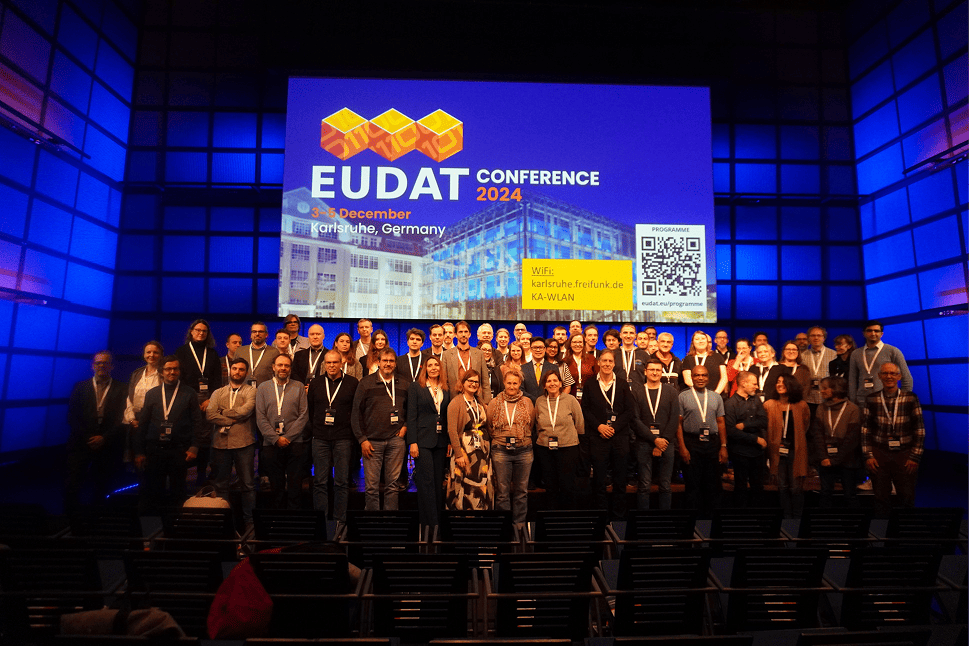
And the community will gather to mark the milestone at the EUDAT Conference 2026 in Prague, 25–27 November.
The next ten years
The 2016 agreement was signed for an initial ten years. As that term closes, the questions facing EUDAT are no longer whether shared European data services can work, but how far they can scale. The coming decade will be shaped by AI-ready data, growing data volumes, the next Framework Programme, and Europe's push for research-data sovereignty.
The founding bet still holds: researchers should not have to rebuild the basics of data management every time a project starts. The members continue to ensure the science becomes the focus for the researchers, with Trust-IT leading communication and outreach activities and actively offering their technical guidance for the build-up of the EUDAT EOSC Node.