From 2 to 4 November 2026, Trust-IT Services took part in the Global ICT Standards Conference (GISC 2026) in Seoul. Launched in 2017, GISC is Korea’s largest international conference on ICT standards and intellectual property. It is hosted by the Ministry of Science and ICT and the Ministry of Intellectual Property, and organised by TTA, ETRI, RRA, IITP, KEA and KISTA.
The big picture: from AI to physical AI
This year’s theme was “ICT Standards and Intellectual Property: Shaping the Physical AI”. Physical AI refers to AI systems that perceive, reason and act in the physical world rather than only on screens, e.g. robots, autonomous vehicles, smart factories and humanoid machines. Its arrival raises new questions for standardisation, as these systems combine AI models, sensors and networks, real-time control, safety requirements. And all of these elements must also work together across vendors and countries. GISC addressed these questions from several angles, from physical AI in manufacturing and robotics, including a public hearing on a Korean Physical AI Standards Framework, to the role of standards in “AX” (AI transformation) and in making AI performance and safety measurable. Dedicated sessions also covered quantum technologies, satellite communications for 6G and standard essential patents (SEPs), the patents that must be licensed to implement a standard.
A new global initiative: the AI Partnership Project (AIPP)
One of the conference highlights was the presentation of the AI Partnership Project (AIPP). On 2 November, ETSI, TTA (Korea) and TTC (Japan) signed a Letter of Intent to explore the options for a possible global, industry-led partnership for AI standardisation, drawing on the collaborative model of 3GPP.
To see why this matters, it helps to recall how 3GPP works. Created in 1998, 3GPP is a partnership of regional standards organisations from Europe, Japan, Korea, China, the US and India. Companies join through these partners and develop a single set of specifications by consensus, published in successive releases, which each partner then turns into its own standards. This model gave the world common standards for 3G, 4G and 5G instead of competing regional ones.
The AIPP aims to explore a similar approach for AI, and is open to further partners worldwide. It is still at an early, exploratory stage. If it develops, it could become an important venue where AI specifications are written, with clear implications for European industry and for European experts’ participation.
Cyber resilience: explaining the CRA to Korean stakeholders
On 3 November, Maria Giuffrida, in representation of CYBERSTAND project, moderated the “Standardisation Session for Cyber Resilience”. This was a closed TTA–ETSI session on EU Cyber Resilience Act (CRA) standardisation cooperation, organised by ETSI as part of the CYBERSTAND project.
The CRA sets cybersecurity requirements for products with digital elements placed on the EU market, and harmonised standards will be the main way to demonstrate compliance. This concerns any manufacturer or supplier selling into Europe, wherever it is based. The session sparked strong interest from the Korean audience. TTA also presented the support services it offers to help companies understand and prepare for these requirements, a concrete example of how cooperation between standards bodies can help international suppliers navigate EU regulation.
Building skills for AI standardisation
On 4 November, Maria also moderated the joint workshop “Driving Global AI Ecosystem: Standardisation Capacity Building Strategy”, hosted by TTA, and presented the StandICT.eu experience in widening participation in ICT and AI standardisation. The panel brought together representatives from Europe and the Asia-Pacific region.
The discussion showed that AI standardisation needs a broader expert profile. Technical expertise has to be combined with an understanding of policy, ethics and codes of conduct across countries, and with the ability to use AI tools responsibly in standards work. Participants agreed that widening participation among women, young professionals and SMEs requires continued, targeted and monitored activities but also that training must be practical and interactive, so that newcomers can see a clear path towards leadership roles.
Our role
Trust-IT Services coordinates and leads communications in both StandICT.eu and CYBERSTAND, two EU-funded projects that strengthen Europe’s presence in ICT standardisation. In this role we build bridges between European and international standards organisations; design and moderate events that make complex regulatory and technical topics accessible to diverse audiences; support experts, particularly from SMEs, academia and research, in contributing to and leading European and international standards work.
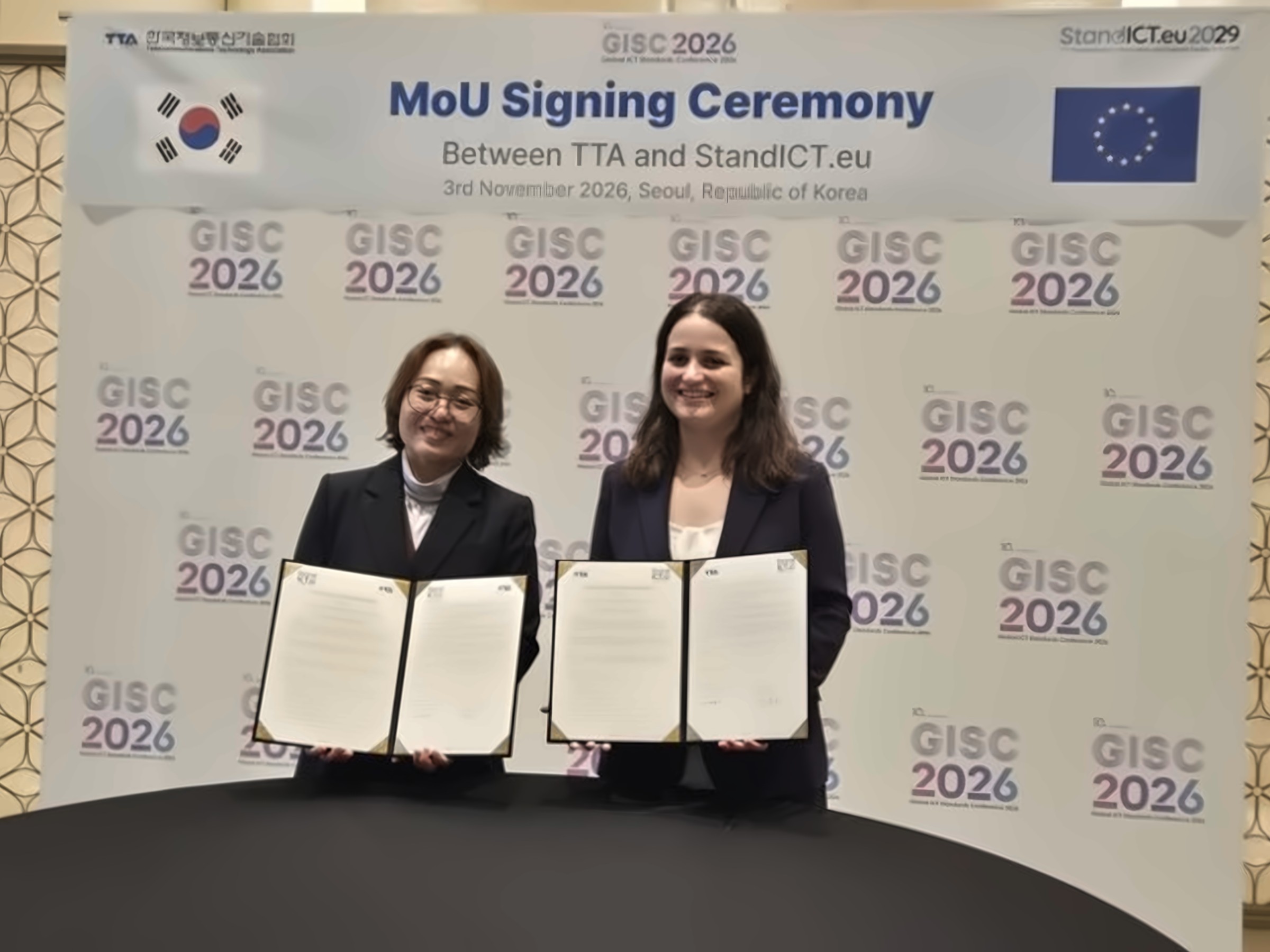
The visit was also the occasion for Trust-IT Services, on behalf of StandICT.eu, and TTA to sign the renewal of their Memorandum of Understanding. The renewal formalises continued cooperation on the joint organisation of events and on technical work towards international standards.