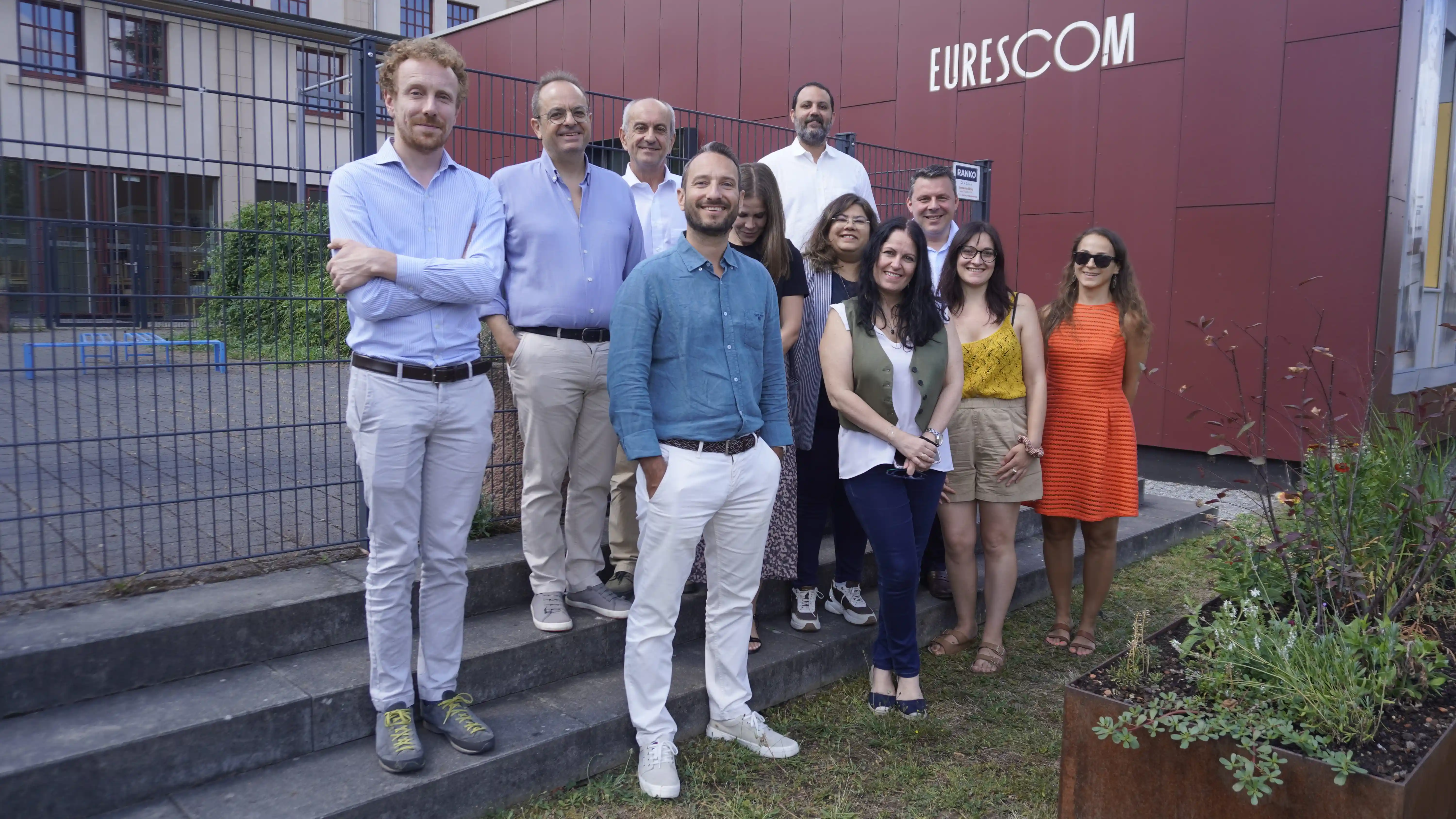
The European path towards a sovereign digital infrastructure has a new coordination engine. INCLUDE (INtegrated CLoud, Edge, and DEvice Stakeholder Alignment) is a 36-month Coordination and Support Action funded under Horizon Europe (HORIZON-CL4-2025-03-DATA-09, Grant Agreement No. 101298498) that will act as the coordination and governance backbone of the 3C Initiative (the European effort to build Connected Collaborative Computing Networks across the Telco-Cloud-Edge-IoT continuum).
This EU-funded CSA combines three complementary lines of action: the consolidation of demand- and supply-side priorities into a shared Technology Roadmap, the facilitation of a Governance Framework agreed with the peer 3C projects, and the curation of a public Catalogue of validated building blocks supported by education and training resources.
The kick-off meeting, held in Heidelberg on 8–9 July 2026, brought the whole consortium together to align on the strategic objectives, the work plans and the shorter-term milestones: the launch of the project's digital channels, the first stakeholder consultations starting in September, and the first Operational Framework for Telco Edge Cloud Components due by the end of 2026.
The INCLUDE mission within the 3C Initiative
INCLUDE sits at the centre of the first phase of the 3C Initiative, acting as the connective tissue between its three peer projects: the supply-side Large-Scale Pilot (DATA-08), the Open Internet Stack (DATA-11), and the Roadmap for Next-Generation Computing Technologies (DATA-10). Its mission is to ensure that what the supply side builds reflects what the demand side (that is Europe's vertical industries, from manufacturing and mobility to health and energy) actually needs, and that the results are governed, catalogued and usable by all.
Over three years, the project will deliver an iterative Stakeholder Technology Roadmap (first version at month 18, final at month 36) backed by dedicated market and monetisation analysis; a Shared Governance Framework defining how Telco Edge Cloud components can be recognised, exchanged and trusted, including open-source licensing and validation practices; and a community-based Software and Infrastructure Catalogue, complemented by a System and Application Developer Handbook released as Open Educational Resources.
The INCLUDE consortium is composed of nine organisations from across Europe, bringing together the industry associations representing the smart networks, IoT/edge and data & AI communities, a leading open-source foundation, a European telecom operator, and specialised SMEs in research coordination, market analysis, innovation management and digital communication. Several INCLUDE partners offer long-standing expertise in stakeholder engagement, community building, open-source governance and the coordination of large European digital-infrastructure initiatives, including the SNS JU and related programmes.
INCLUDE and the EU Tech Sovereignty Package
The project starts at a pivotal policy moment. On 3 June 2026, less than a month before INCLUDE's launch, the European Commission adopted the Tech Sovereignty Package, (comprising the Chips Act 2.0, the Cloud and AI Development Act (CADA), the EU Open Source Strategy and a Strategic Roadmap for Digitalisation and AI in Energy), to reduce the EU's reliance on non-EU providers, which today covers over 80% of key digital products, services and infrastructure.
INCLUDE operationalises this agenda in the Telco-Edge-Cloud domain. Where CADA aims to expand Europe's sovereign cloud and AI capacity, INCLUDE provides the converged roadmap and governance that give investors, providers and adopters a shared plan, in a market where European providers currently hold around 15% of a European cloud market worth over €60 billion. Where the EU Open Source Strategy places open source at the centre of technological sovereignty, INCLUDE delivers the practical machinery: an open-source governance model, validation criteria and a public catalogue of reusable building blocks aligned with initiatives such as Sylva, Anuket, Nephio, CAMARA and IPCEI-CIS.
The project's findings will also feed back into the EU policy cycle through structured policy briefs, contributions to public consultations, and sustained engagement with DG CNECT, ENISA and the standardisation community.
Trust-IT's Role
Trust-IT leads WP4: “Stakeholder Engagement, Dissemination, Communications & Impact Assessment”, which includes the definition of the communication concept and brand identity of the whole 3C Initiative, shared with the peer DATA-08, DATA-10 and DATA-11 projects, and for delivering the Communication, Dissemination, Engagement and Exploitation Plan, the project website, the social media channels and the newsletter.
Trust-IT also leads the impact monitoring and sustainability work of the project, running the consultation forum and authoring the final impact report and sustainability strategy that will chart the long-term life of the 3C Initiative's assets. Finally, Trust-IT leads the cooperation with 3CN/OIS experts, engaging a pool of technology, research and policy advisers to guide adopters of the 3C building blocks, and continues to evolve its tracker tools, building on the standards and vertical-engagement trackers developed in the SNS ecosystem.
Follow the INCLUDE project on LinkedIn to stay updated on the roadmap consultations, the building-blocks catalogue and upcoming community events.